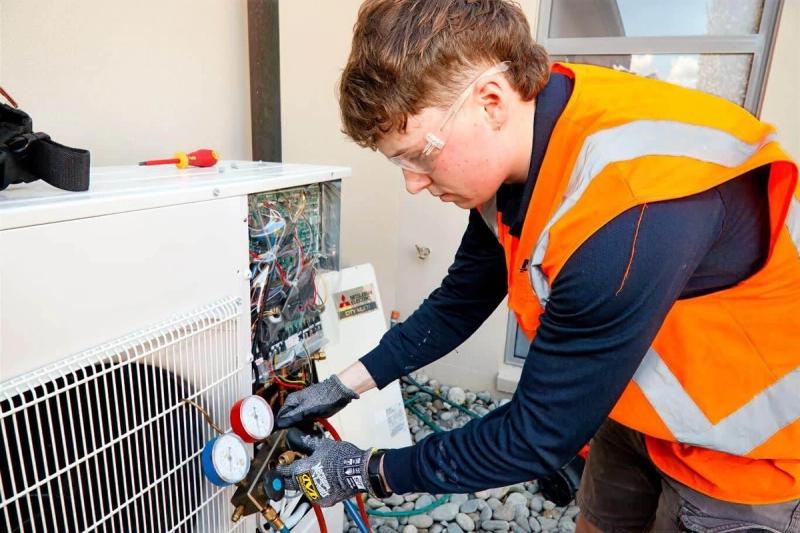
Many installers already handle R32 every week. As new starters join and more lower-GWP equipment comes through, everyone on the team needs the same working knowledge of what an A2L refrigerant requires, from the site survey through to recovery.
Why Heat Pumps Are Moving To A2L Refrigerants
Since 2020, New Zealand has been reducing bulk HFC imports in steps under a permit system, in line with its commitments under the Kigali Amendment to the Montreal Protocol. Across the industry, manufacturers have moved much of their equipment to lower-GWP refrigerants.
R32 is the most familiar of these in residential split systems. Other A2L refrigerants are appearing in newer equipment, and hydrocarbons such as R290, classed A3, are used in some heat pump products.
Existing R410A systems stay in service, and R32 can't be used as a replacement refrigerant in them. Many teams will be installing R32 and servicing R410A side by side for some time.
What The A2L Rating Means On Site
Refrigerants are classified for toxicity and flammability under AS/NZS ISO 817. The "A" indicates lower toxicity. "2L" indicates lower flammability: an A2L refrigerant is hard to ignite and burns slowly. For comparison, R410A is classed A1, with no flame propagation under test conditions, while R290 is A3, the higher flammability class.
R32 will still burn under the right conditions: a leak that builds to a high enough concentration in an enclosed space, then meets an ignition source.
R32 also runs at pressures close to R410A's, so the pressure side of the work is familiar ground. The new requirements come from flammability, and they show up at almost every stage of a job.
What Changes Through An Install
Site Survey And Quoting
R32 systems can carry minimum room-size requirements, but these don’t apply identically to every system. They depend on factors including the equipment type, refrigerant charge, installation configuration and the applicable standards.
Pipe runs work the same way. Whether a longer run needs additional refrigerant, and how much, depends on the manufacturer’s specifications for that unit.
Before quoting, installers need to check the requirements for the specific equipment against the proposed installation, including the rooms being served, the pipe route and where indoor units will sit. Ducted indoor units need particular attention, because leaked refrigerant can collect in ceiling spaces and ductwork.
Tools And Equipment
Vacuum pumps, recovery units, manifolds and leak detection equipment need to be rated for use with A2L refrigerants. Anything that could create a spark, including extension leads and power tools that aren't rated, should stay clear of the work area while refrigerant could be present.
Brazing, Testing And Commissioning
The order matters here, and each step has its own purpose.
- Recover and make it safe. Where the system already holds refrigerant, it must be properly recovered and the system made safe before any brazing begins.
- Braze with dry nitrogen flowing. Nitrogen flowing through the pipework during brazing prevents internal oxidation and contamination. It isn’t used to remove refrigerants, which is why recovery comes first.
- Pressure test and leak check. Nitrogen pressure testing and leak checking confirm the joints are sound before refrigerant is introduced, which carries extra weight with a flammable refrigerant.
- Evacuate, charge and commission. The system is evacuated, then charged and commissioned following the manufacturer’s procedure for that specific unit.
Approved Filler Certificates And Refrigerant Classes
Filling a refrigerant cylinder, including recovering refrigerant into a separate recovery cylinder, generally requires an Approved Filler compliance certificate under the Health and Safety at Work (Hazardous Substances) Regulations 2017.
Certificates are issued for specific refrigerant classes. Our Approved Filler certification options cover A1 only, A2L and A2 (including A1), or A3 (including A1, A2 and A2L). Our Approved Filler (Refrigerant) course covers refrigerant properties, hazards and safe filling practices, including flammable refrigerants. A refresher is also available for those who have previously completed ATNZ's course.
If your team's certificates cover A1 refrigerants only, check their certification before anyone recovers R32 into a cylinder. R32 is classified as A2L and requires certification covering that class.
Building A2L Skills Across The Team
Training needs look different for a new installer and a senior technician who has been fitting R32 systems for years.
For new installers, the New Zealand Certificate in Air Conditioning Installation (Trade) (Level 4) develops skills across site assessment, installing split, VRF and packaged systems up to 50 kW, pipework and ductwork, commissioning and safe work practices. It's workplace-based, carries 140 credits and takes approximately 24 months. It also leads to the New Zealand Certificate in Refrigeration and Air Conditioning (Trade) (Level 4), part of our refrigeration and air conditioning pathway.
For experienced installers with a defined need, individual standards can focus on the refrigerant side of the work. Our air conditioning installation standards include US 31142, which covers refrigerant legislation, commonly used refrigerants such as R32, and labelling and handling precautions. The collection also includes US 23959 for preparing and purging braze piping.
Where assessment-only is available, eligible installers who already have the skills can go straight to assessment and gain recognised NZQA credit for what they can already do. Assessment requirements still apply. Individual standards sit alongside the full qualification. They build or confirm skills in a defined area and don't replace broad trade development.
Planning Your Team's A2L Training
Start with the refrigerant classes your team handles now and the equipment you expect to install over the next year. Book a call with our team and we'll help match each person to the qualification, standards or Approved Filler certification that fits their role.